Some thoughts arrive already knowing their names. Others introduce themselves slowly.
A color can carry a memory. A word can arrive with three thousand years of luggage. Scripture can sit beside slang and reveal that both have been describing the same human weakness in different centuries. An image becomes a sentence. A sentence becomes an object. Something humorous wanders into something sacred and, instead of diminishing it, turns on another light.
For a long time, I thought creativity was primarily about what a person made. Now I am equally interested in what happens before the making: the noticing, the association, the quiet recognition that two things filed under entirely different categories may have something to say to one another.
That interior process interests me because so much of it occurs before there is anything to show for it. Before the article, the image, the object or the title, there is simply attention moving among possibilities.
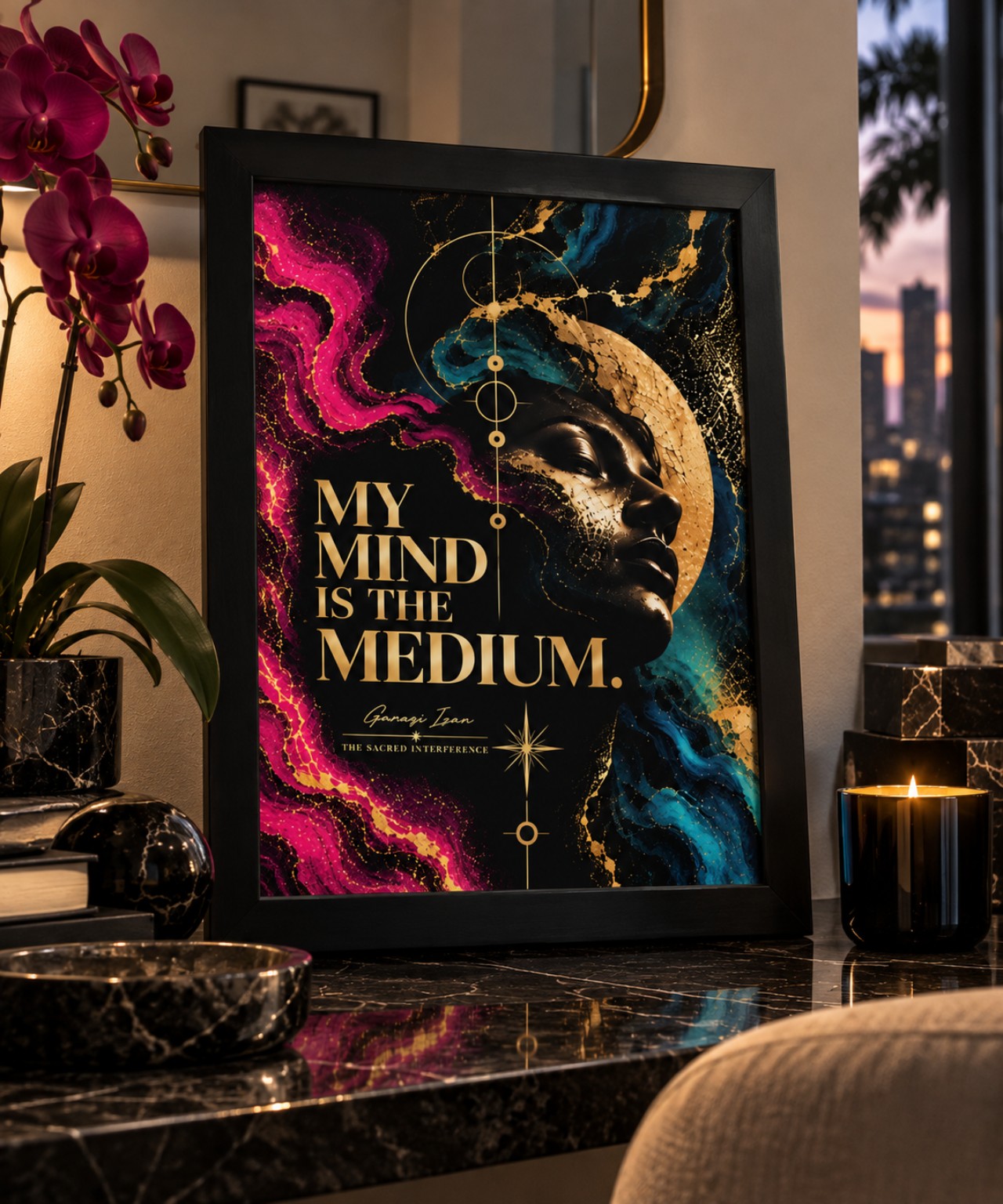
My mind is the medium.
Not because every thought demands an audience. Quite the opposite. The mind is generous with possibilities; discernment decides which ones deserve form.
The work happens between arrival and expression.
I am interested in that strange internal jurisdiction where an observation is cross-examined by memory, challenged by intuition, sharpened by humor, checked against what I know, disturbed by what I don’t know, and finally released wearing clothes it did not arrive in.
That is where my work happens. And increasingly, I suspect that is one place originality can happen too.
We have mistaken originality for creating something from nothing, but nothing comes from nothing. Every artist works inside an inheritance: language we didn’t invent, colors we didn’t discover, symbols older than our surnames, stories told before our grandparents had grandparents.
Originality is not the absence of influence. It is the character of the transformation.
What interests me is not whether an idea has ancestors. Of course it does. I want to know what happens when inherited language meets present experience; when an old symbol is examined by contemporary eyes; when beauty is asked to carry an argument; when humor is permitted into a serious room without being asked to surrender its intelligence at the door.
Perhaps that is the more interesting artistic ambition.
I don’t want to escape everything that has entered my thinking. I want to examine it. Turn it around. Place it beside something it has never been placed beside before.
Ask whether the accepted interpretation is the only interpretation. Ask whether the sacred can withstand humor. Ask whether beauty can carry an argument. Ask whether an ordinary object can carry an idea. Ask whether two apparently unrelated subjects have been corresponding all along and simply needed an introduction.
That is why The Sacred Interference was probably named before I completely understood what I was naming. It is not simply a title. It describes a method of attention: allowing one idea to enter the territory of another—and paying attention to what becomes visible when it does.
That, to me, is interference.
And perhaps the most interesting thing about having the mind as a medium is that the finished work is never merely a record of what entered it.
It is evidence of what attention made possible.
Garazi Izar | The Sacred Interference