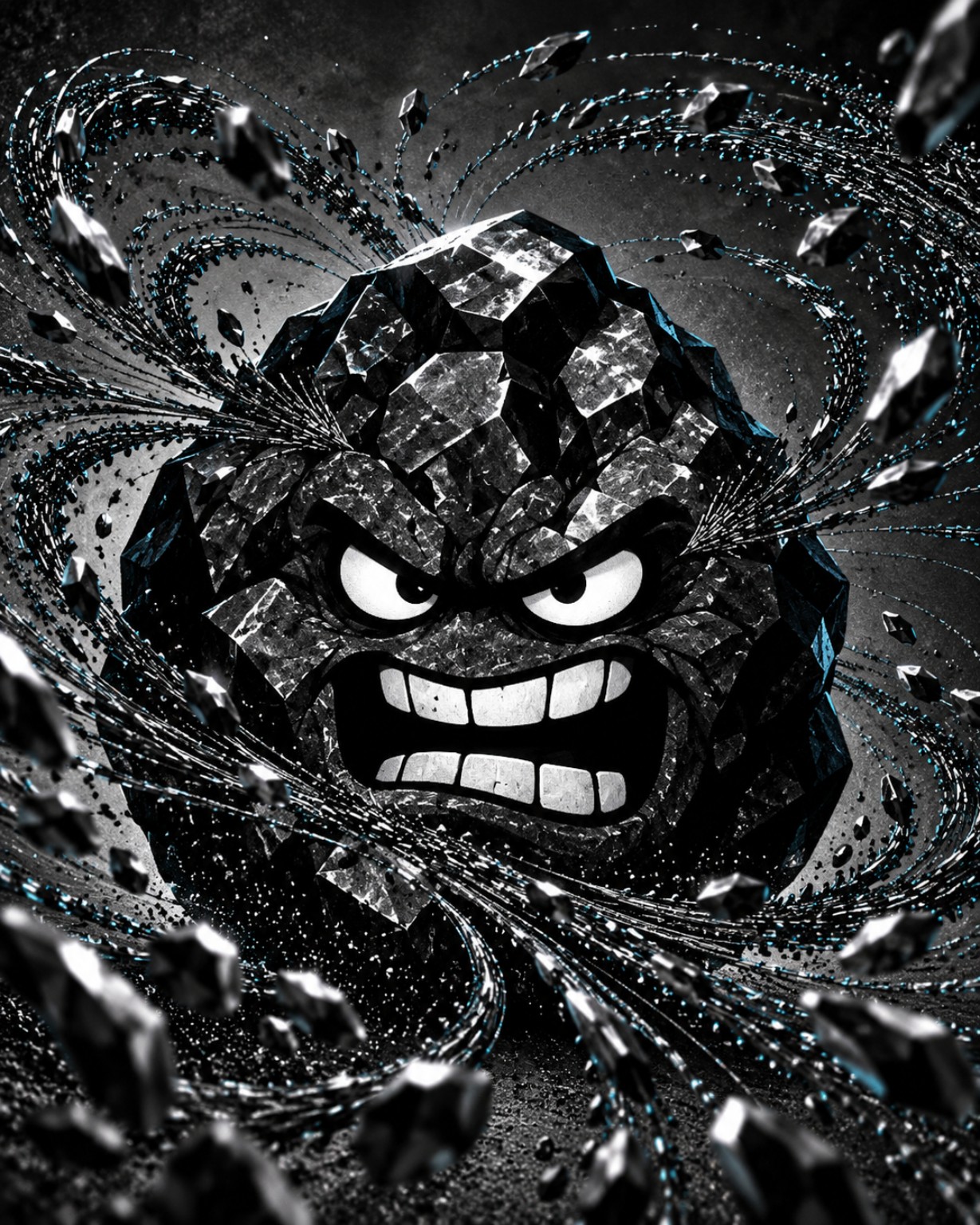
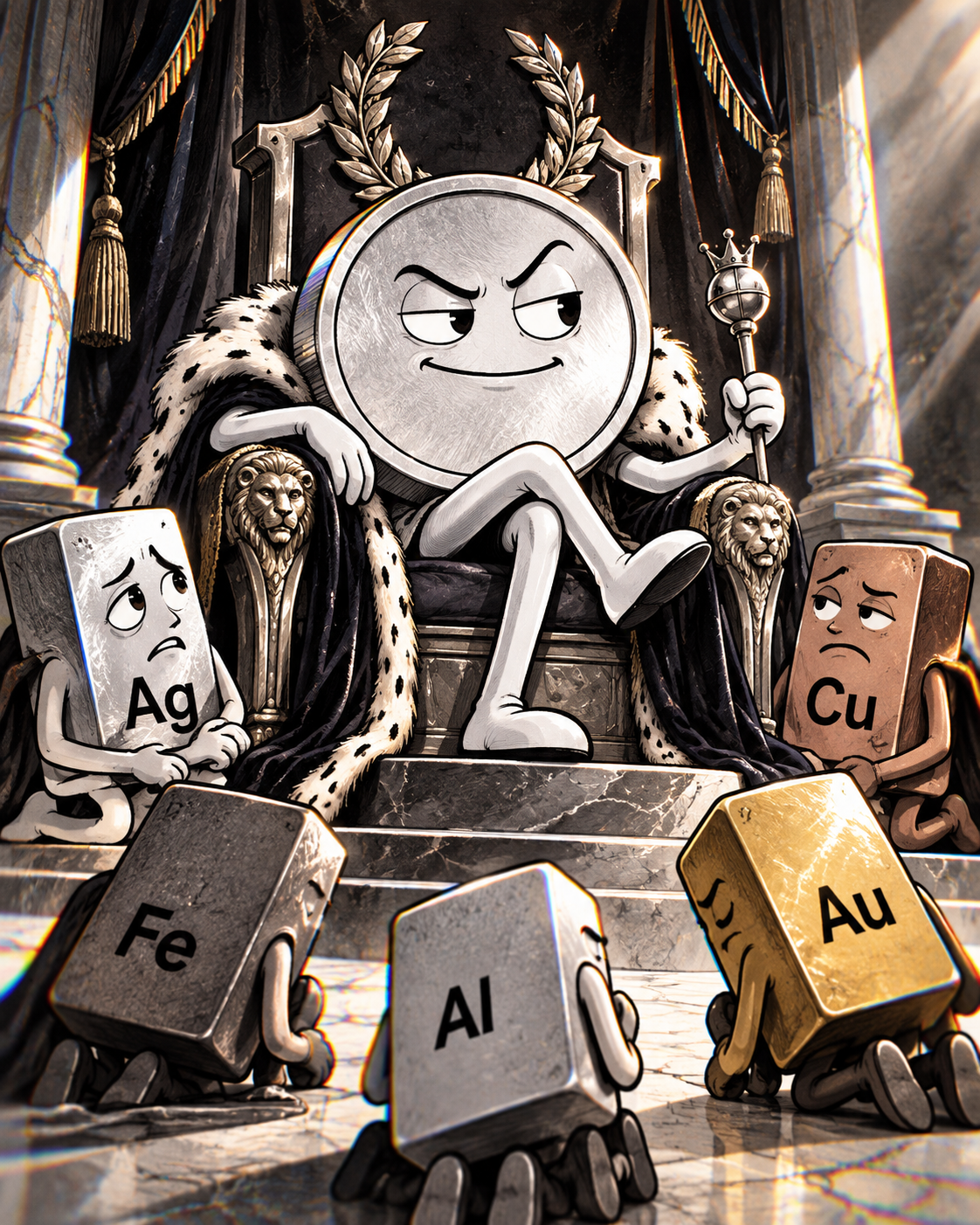
Chemistry, character study and cosmic side-eye. Seven materials enter the conversation. Their résumés are impressive. Their personalities are a liability.
Nickel did not come here to be precious. Nickel came here to survive your keys, your coins, your kitchen, and your disrespect.
If metals had a group chat, gold would post yacht pictures, silver would correct everybody’s grammar, and Nickel II would type, “interesting,” then remember the offense until the heat death of the universe. This is a metal with boundaries. It resists corrosion, strengthens alloys, and has the emotional availability of a locked filing cabinet.
Its famous compounds often wear green or blue-green—colors that say healing retreat, behavior that says collections department. Nickel-containing alloys work in batteries, turbines and harsh environments. It is useful precisely because it can take pressure without turning the whole situation into a memoir.
Nickel is not cheap. Nickel is economically efficient and tired of explaining itself.
The sacred lesson? Durability is not glamour, but glamour keeps quietly hiring durability to hold the building up. Still, do not romanticize toughness until you become emotionally stainless. Nickel exposure can cause allergic skin reactions in some people. A boundary may protect you; a permanent barricade just leaves you alone with excellent hardware.
PPOV verdict: Petty? Occasionally. Essential? Annoyingly. Nickel is the friend who says “do whatever you want,” then provides the load-bearing infrastructure for whatever you wanted.
Colloidal Gold — The Overachieving Socialite in Your Wellness Cabinet
One tiny gold particle enters the bloodstream and immediately asks who catered the mitochondria.
Gold has spent human history being worshipped, hoarded, stolen, crowned, buried and turned into a financial personality disorder. Then somebody made the particles tiny, suspended them in liquid, and gave royalty a dropper bottle. Naturally, wellness marketing began speaking in the dialect of miracles.
Gold nanoparticles are genuinely interesting in research because their optical and surface properties can be engineered. That does not mean a retail bottle has been proven to upgrade memory, mood, consciousness or your group-chat intuition. “Scientists are studying it” and “drink this before Pilates” are not the same sentence.
Luxury is not a mechanism of action.
Symbolically, gold carries radiance, incorruptibility and the solar self. Fine. Use it as a mirror: where are you confusing visibility with value? Where are you buying the costume of transformation because transformation itself refused to come with free shipping?
PPOV verdict: Gold remains brilliant, conductive, chemically reluctant and deeply photogenic. The claim that a colloid turns your brain into Studio 54 needs evidence, not mood lighting.
Reality check: This is cultural commentary, not medical advice. Do not ingest colloidal products for health claims without discussing the product and evidence with a qualified clinician.
Colloidal Titanium — The Glittery Overachiever Nobody Assigned
Titanium heard “lightweight” and built an aerospace career out of taking it personally.
Titanium has the résumé of a person who makes you regret asking what they do: aircraft, implants, pigments, architecture, sports equipment. Strong, corrosion-resistant and relatively light, it strolls through engineering with the unbearable calm of someone whose LinkedIn recommendations are all from NASA.
Then comes the colloidal edition: titanium reduced to very small particles, suspended, bottled and introduced with language so ambitious it should have its own venture-capital round. Nanomaterials can behave differently from larger forms of the same substance; size, coating, dose and route of exposure matter. That complexity is a reason for careful study, not an excuse to improvise a health halo.
“Advanced material” is a category, not a dosage instruction.
As metaphor, titanium asks: can you be strong without becoming heavy? Can you resist corrosion without pretending nothing touches you? The mature version of resilience is not invulnerability. It is knowing what you can carry—and refusing to turn endurance into unpaid labor.
PPOV verdict: An elite material with executive presence. In a plane or medical device, it has a job description. In an unverified wellness pitch, it is standing near the word “nano” looking expensive.
Reality check: “Titanium is useful” does not establish that ingesting a colloidal form is useful or safe.
Pink Sapphire — The Gem Who Knows Too Much (and Throws Subtle Shade)
“I forgive you,” says Pink Sapphire, while filing your behavior under a tab marked Patterns.
Pink sapphire is corundum, the same mineral family as ruby. The border between deeply pink sapphire and ruby can become a gemological custody battle involving color, tradition and market language. Chromium helps bring the pink-to-red drama. Translation: a tiny trace element entered an aluminum-oxide crystal and changed the entire room. Relatable.
This stone’s imaginary gift is observational literacy. Pink Sapphire noticed the compliment had a small knife inside it. Pink Sapphire heard “I’m just being honest” and checked whether honesty had recently been seen traveling with cruelty. She does not create conflict; she merely refuses to let euphemism leave the scene unidentified.
Forgiveness may release the debt. It does not require deleting the receipt.
Symbolically, pink stones are often assigned love, tenderness and healing. PPOV adds discernment, because tenderness without discernment is just an unlocked front door with excellent throw pillows. The wiser heart stays soft enough to feel and sharp enough to notice.
PPOV verdict: Beautiful, durable and constitutionally incapable of pretending that “mixed signals” were not, in fact, a complete message.
Magnetite walks into the geology function and every loose piece of iron suddenly has plans.
It is dark and naturally magnetic. Lodestone—naturally magnetized magnetite—helped humans make early compasses. So yes, Magnetite has been giving direction since before your life coach discovered ring lights. It does not chase. It establishes a field and lets susceptible material embarrass itself.
But attraction is not compatibility. A magnet can pull something close without knowing whether it belongs there. That is the spiritual lesson hidden inside the science: intensity tells you a force exists; it does not tell you the force is wise. Chemistry has bonds. Therapy has boundaries. Instagram has “twin flames.” Please choose your laboratory carefully.
Having pull is not the same as having range.
Magnetite is an important iron ore and contains iron in two oxidation states—an internal complexity beneath the monochrome outfit. The rock is literally more nuanced than some men’s podcasts.
PPOV verdict: Hot? Thermodynamically, that depends. Charismatic? Absolutely. Magnetite enters silently, rearranges the silverware and calls it natural leadership.
Rare, dense and corrosion-resistant: Iridium has survived conditions that would make your “high-vibration” acquaintance cancel brunch.
Iridium is one of the platinum-group metals and one of the rarest elements in Earth’s crust. It is hard, brittle and famously resistant to corrosion. A global layer enriched in iridium helped support the asteroid-impact explanation for the mass extinction at the end of the Cretaceous. Imagine being so cosmically incriminating that your trace presence becomes geological testimony.
Its name comes from Iris, the rainbow, because some iridium salts show varied colors. Naturally, the metal itself responded by appearing silvery-white and refusing whimsy. It is used where endurance under extreme conditions matters, including spark-plug contacts and specialized alloys.
Iridium does not need to be everywhere. It needs to be undeniable where it is.
As a symbol, it corrects the internet’s obsession with constant visibility. Rarity is not hiding. Resistance is not numbness. Some things are powerful because they do not react to every atmosphere that tries to claim them.
PPOV verdict: A cosmic witness with no interest in networking. Iridium arrives after the impact, remains chemically unbothered, and lets the sediment keep the minutes.
Gold wants applause. Platinum wants the room to understand that applause has quality grades.
Platinum is dense, scarce, silvery and exceptionally useful as a catalyst—a substance that helps reactions happen without being consumed by them. That alone is enough to give it a leadership complex. It has served in catalytic converters, laboratory equipment, jewelry and medicines. Platinum does not simply enter the room. Platinum improves the room’s conversion rate.
Status culture then flattened an element into a loyalty tier: platinum card, record, membership. Humanity looked at a serious catalytic metal and said, “Could this help people skip a line?” The metal has never recovered from the branding opportunity.
Real influence changes the reaction without needing to become the reaction.
The most powerful person is not always the loudest reagent in the beaker. Sometimes influence is creating conditions in which something difficult can finally occur. But beware the person who calls themselves a catalyst when what they mean is “I started chaos and left before cleanup.”
PPOV verdict: Distinguished, effective and giving a 42-minute keynote scheduled for twelve. Platinum is not saying you can never be it. Platinum is saying there are prerequisites, and apparently one is density.